

 From Chaos to System
AI Operating System

An AIOS (AI Operating System) is an autonomous infrastructure layer built on three pillars — the Business Context Data Engine, Dashboard Intelligence, and Automated Task Management.
That's not a pitch.
That's a Tuesday — when your business runs on the right infrastructure.
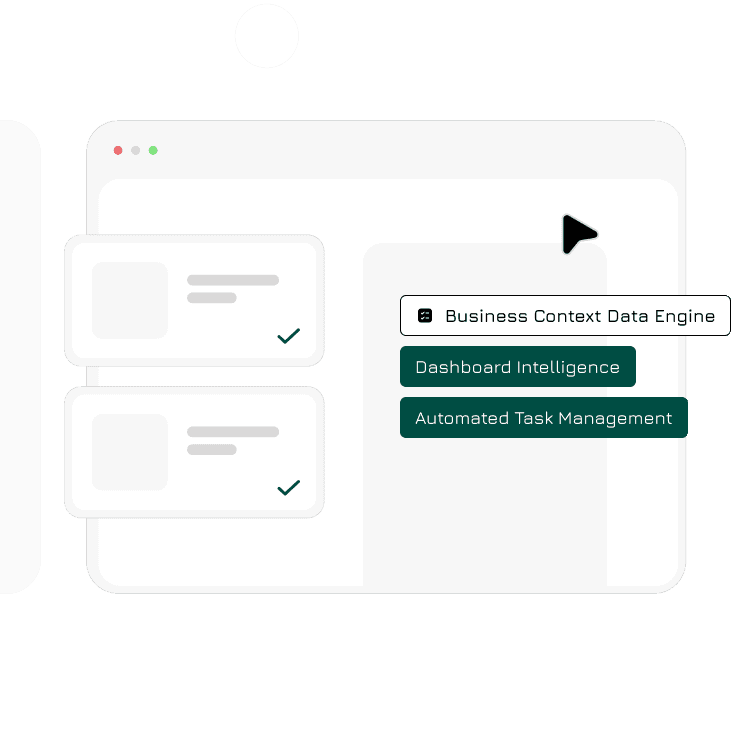
Together, they invert the founder's time ratio
from 80% maintenance / 20% growth
to 20-30% maintenance / 70-80% growth.
The system compounds in value over time, becoming an appreciating business asset rather than a recurring cost.
What an AIOS Actually Is
An AIOS (AI Operating System) is an autonomous infrastructure layer that wraps around an entire business — operations, data, intelligence, and communications — and runs whether the founder is at their desk or not.
It's not a tool you open. It's infrastructure that runs. It knows your business the way a co-founder would — your team, your products, your financials, your priorities — and it acts on that knowledge every day.
That's the system we build.
Three layers, configured around your operations. Each one reinforces the others —
the context layer
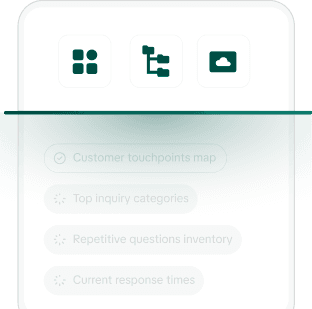
The result is a system that gets better the more you use it.

Your AI knows your business - fully.
The Business Context Data Engine is a structured knowledge layer that gives AI complete understanding of your business - team, products, financials, priorities, and decision history.
The Business Context Data Engine gives your AIOS the complete picture:
- Your identity, background, communication style
- Business model, products, revenue
- Every key person, role, responsibilities
- What's urgent right now
- Annual and quarterly targets
- Every major decision with reasoning
- Individual folders per active project
Plus connected data sources - Stripe, Google Analytics, CRM, marketing platforms - consolidated into one place your AI can query.
This is why chatbots get you fifty percent of the way there. The AIOS methodology is designed to push output quality to ninety percent once full business context is in place.
The difference is context. Context is not optional - it is the foundation.
The most informed person in your organization. Before 8am.
Dashboard Intelligence is an AI-powered daily briefing system that synthesizes data from every connected business platform into a single morning report.
It synthesizes everything happening across your business:
Revenue changes and anomalies
Summaries of every call and meeting - including ones you did not attend
Team updates and key decisions
Content performance
A SWOT analysis across the entire business
Emerging opportunities and signals
One read. Before breakfast. Replaces logging into seven platforms and sitting in every call.
The system can analyze 74 calls overnight across multiple business streams and summarize them into one brief with deeper analysis attached.
You check the health of your business the same way you would check a weather app. One glance.
60 - 70% of your recurring tasks. Handled.
Automated Task Management audits every recurring business task and categorizes each as automate, augment, or manual - with an AIOS target of 60-70% automation.
We categorize each task:
 Automate
Simple, rule-based tasks the AI handles fully. Hands-off.
 Augment
Complex or creative tasks where AI does the heavy lift and you review. Minutes instead of hours.
 Manual
Still requires you. These shrink over time as the system learns.
The target: sixty to seventy percent of your operational workload, automated or heavily augmented. Every task you wrap in automation is bandwidth you never lose again. It compounds.
A real example: a discovery call transcript goes in. The AI produces a completed scoping and proposal deck. The founder reviews and sends.
When the three pillars are running together,
the math changes
Before:
80% of your time IN the business.
20% ON the business.
After:
20-30% IN the business.
70-80% ON the business.
That freed bandwidth is yours. Pour it into growth — new channels, new products, new markets. Or step back and run the business from your phone. Or both. The founders who make this shift describe it the same way: like pointing a laser beam at the things that actually matter.
We measure three things for every client: away-from-desk autonomy, task automation percentage, and revenue per person. If those numbers aren't moving, we haven't done our job.
Compound Intelligence
Compound Intelligence is the principle that an AIOS accumulates knowledge over time — every decision logged, every skill refined — becoming an appreciating asset rather than a recurring cost. Unlike chatbots, which are stateless and start from zero every session, an AIOS builds on everything it learns.
Every research report saved. Every decision logged. Every skill refined from feedback. Every automation tuned. After a month of daily use, the system knows the business deeply. After a year, it's institutional memory that can't walk out the door.
This isn't a subscription you pay for. It's an asset you build. The longer it runs, the more valuable it becomes. Context compounds. Every module makes every other module smarter. A year from now, the system running your business will be fundamentally more capable than the one we deploy on day one — and you didn't have to build any of it yourself.
Scope and Expectations
The bandwidth inversion targets described above (80/20 → 20-30/70-80) represent the design goal of the AIOS methodology, not a guaranteed outcome for every business.
Results depend on operational complexity, data readiness, team structure, and how deeply the system is adopted. We assess fit during the free consultation and set realistic expectations before any engagement begins.
